
🧴
ShopDe.ee
An honest review of Fairy dishwashing liquid. Learn about the brand's history, grease-cutting performance, strengths, weaknesses and whether German Fairy really differs from products sold in Estonia.
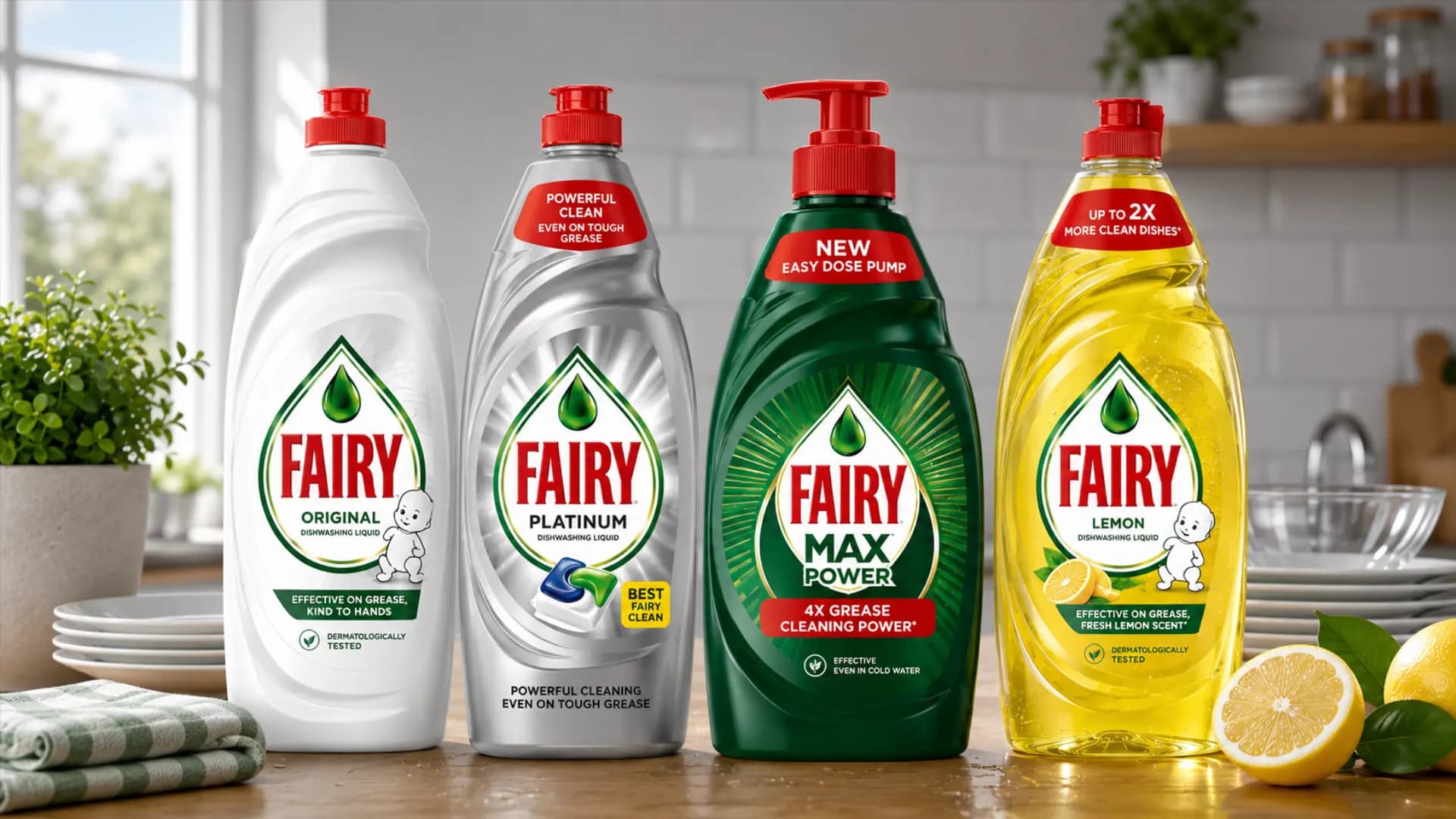
Fairy has become much more than just the name of a dishwashing liquid. In many households people simply say 'Fairy' when referring to any dish soap. That level of recognition did not happen overnight. For decades the brand has built its reputation around concentrated formulas, excellent grease removal and economical everyday use. But popularity also raises questions. Is Fairy really better than cheaper alternatives? Does the German version perform differently from the one sold in Estonia? And is the higher price actually justified?
The Fairy brand has existed for decades. Originally associated with household soap, it gradually became one of Europe's best-known dishwashing brands. Today Fairy is part of Procter & Gamble's portfolio and is sold throughout much of Europe.
Outside Europe many consumers know a closely related brand called Dawn. Both belong to Procter & Gamble and are developed using the company's cleaning expertise. However, products sold under the two names should not automatically be considered identical, as formulations, fragrances and product ranges may vary between markets.
Fairy's popularity has always been built around one simple promise: a concentrated formula that can clean greasy dishes using only a small amount of liquid.
Grease does not dissolve naturally in water. Dishwashing liquids rely on surfactants that surround grease particles and allow them to be washed away. These ingredients are responsible for most of the actual cleaning work.
Fairy's performance is not based on one secret ingredient. Instead, it combines different surfactants, solvents and supporting ingredients designed to work together. The formula spreads easily across a sponge, produces stable foam and continues breaking down grease even during longer washing sessions.
Many people associate thick foam with stronger cleaning power, but foam itself is only one part of the experience. Actual performance depends on the overall formula, water temperature, the amount of grease and correct dosing.
The famous advertising slogan about washing many dishes with one drop is memorable, but real kitchens are more complicated. One small drop may be enough for lightly used plates or glasses, while heavily greased cookware naturally requires more detergent.
Water hardness also affects the washing experience. In harder water, foam behaves differently and consumers may feel that the detergent performs differently even when using the same product.
The most realistic way to view Fairy is as a concentrated dishwashing liquid that can often last longer than many cheaper alternatives when used correctly.
The biggest practical difference is usually concentration and consistency. Many budget products need to be reapplied more often, especially when washing greasy cookware. Fairy typically maintains its cleaning performance for longer before additional detergent is needed.
That said, a higher purchase price does not automatically mean better value. A fair comparison should always consider bottle size, recommended dosage and the actual cost per wash.
For households that mostly wash lightly used dishes, mugs and glasses, the difference between Fairy and a good budget detergent may be relatively small.
Many shoppers believe that household products purchased in Germany are automatically superior. While people sometimes notice differences in fragrance, bottle design or consistency, these observations alone do not prove that one version is objectively better.
Different countries often receive different Fairy product lines. For example, one market may sell Original, Max Power or Sensitive variants while another focuses on different fragrances or packaging formats. Comparing different product lines is not the same as comparing regional versions of the same product.
The most reliable comparison is between two bottles with exactly the same product name, purpose and size. Only then does it make sense to compare ingredient lists, dosage recommendations and overall performance.
This belief has existed for many years across Europe. Imported products were once associated with higher quality, and unfamiliar packaging often reinforced that impression.
Today Germany and Estonia are both part of the European Union, where detergents are subject to common safety and labelling requirements. Manufacturers may adapt their product ranges for local markets, but that does not automatically mean one country receives higher-quality products.
A more balanced conclusion is that individual products may differ, but quality should be judged by the specific product rather than the country where it was purchased.
Fairy shows its greatest strengths when dealing with greasy cookware after frying, roasting or preparing oily meals. It is also an excellent everyday choice for plates, bowls, glasses and cutlery.
Some people also use Fairy as a pre-treatment for greasy stains on clothing. This can sometimes help because the detergent is designed to break down fats, but it should always be tested on an inconspicuous area first, especially on delicate fabrics.
Although Fairy is occasionally used for cleaning other household surfaces, it is primarily designed for dishwashing. Delicate materials such as natural stone, wood or specialised coated surfaces should be cleaned using products intended for those materials.
The first obvious drawback is its price. Fairy is often more expensive than lesser-known brands. Lower consumption can offset part of this difference, but only when the detergent is used economically.
Some fragrances may also feel too strong for people who prefer lightly scented products. In addition, frequent exposure can leave sensitive skin feeling dry, making gloves a sensible choice for people who wash dishes regularly.
Finally, Fairy is not a miracle solution. Burnt-on food and heavy carbon deposits still require soaking and mechanical cleaning regardless of the detergent being used.
Fairy's reputation is based on more than advertising. It is a well-developed and concentrated dishwashing liquid that performs particularly well on greasy cookware while often requiring relatively small amounts per wash.
However, it is not automatically the best choice for every household. If you mostly wash lightly soiled dishes, a good budget detergent may provide very similar everyday results.
There is usually little reason to search specifically for the German version. Instead, compare the exact product line, ingredients, intended use and value for money. The country of purchase alone is not a reliable indicator of quality.
Our conclusion is simple: Fairy remains one of the strongest and most reliable dishwashing brands available today, but it should be chosen because of its actual performance rather than myths about where the bottle was purchased.
Does Fairy really remove grease better?
Fairy is widely recognised for its strong grease-cutting performance, particularly on heavily soiled cookware. Results still depend on the specific product, water temperature and correct usage.
Is German Fairy better than Estonian Fairy?
Not necessarily. Different product lines may vary, but the country where the product is sold does not automatically determine its quality.
Why does Fairy often last longer?
Many Fairy products are highly concentrated, meaning smaller amounts are needed for everyday dishwashing.
Can Fairy dry your hands?
Yes. Frequent contact with dishwashing liquid may dry sensitive skin, so gloves are recommended for prolonged use.
Can Fairy be used on greasy clothing stains?
It is sometimes used as a pre-treatment for grease stains, but it should always be tested on a hidden part of the fabric first.
Are Fairy and Dawn the same product?
Both belong to Procter & Gamble, but products sold under the two brands may differ in formulation, fragrance and product range depending on the market.
Is Fairy worth the extra money?
For households that frequently wash greasy cookware, the concentrated formula may justify the higher price. For lighter everyday washing, a good budget alternative may offer similar value.