🧴
ShopDe.ee
A detailed comparison of Korean, Japanese and Chinese cosmetics: skincare philosophy, formulas, textures, innovation, pricing and quality. Discover the differences between K-Beauty, J-Beauty and C-Beauty.
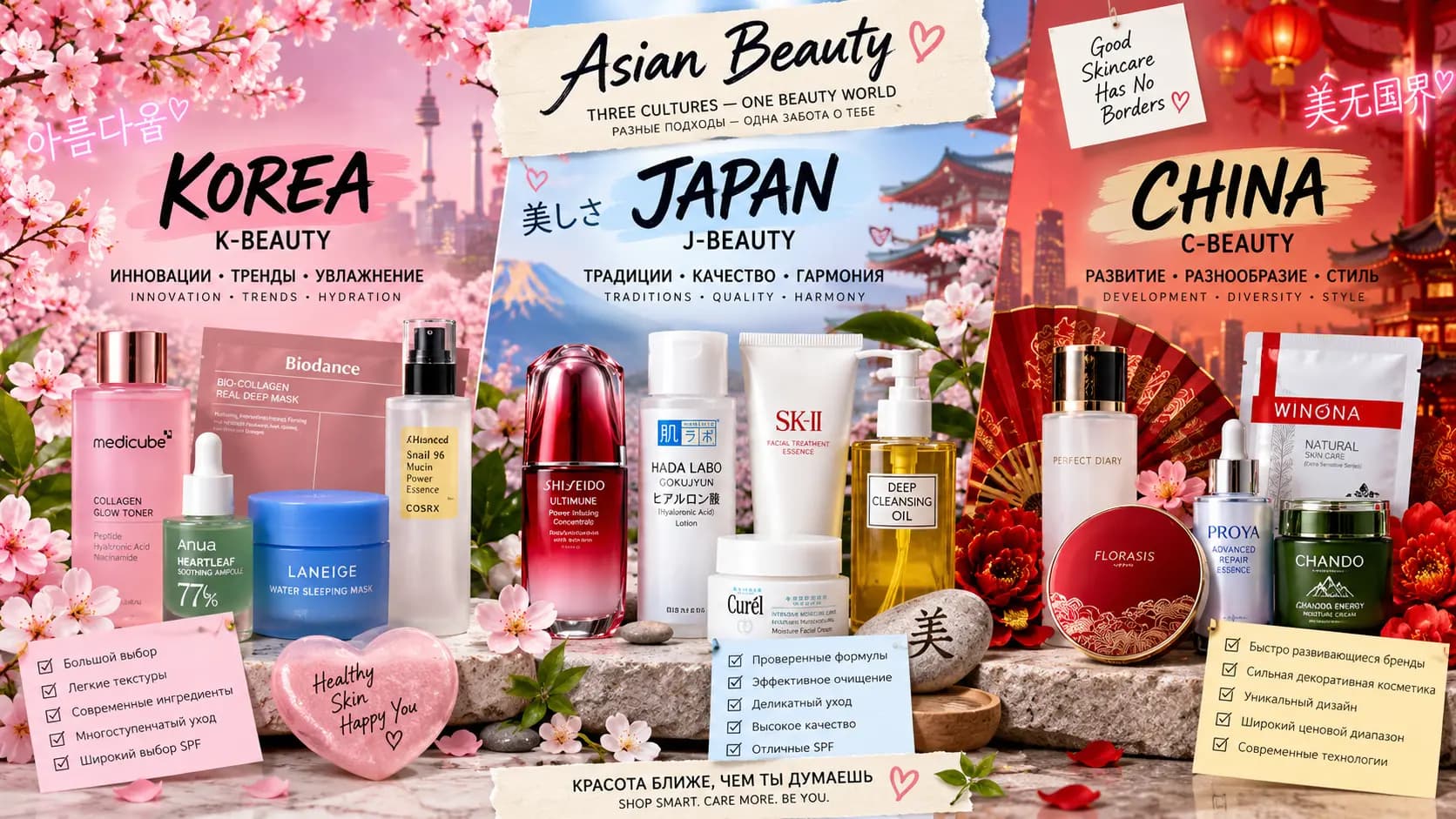
Korean beauty has become a global phenomenon, Japanese cosmetics have been respected for decades, and Chinese brands are increasingly attracting attention outside their domestic market. This naturally raises a question: which is better — K-Beauty, J-Beauty or C-Beauty? A better approach is to compare philosophies rather than countries. All three markets produce excellent products, average products and disappointing ones. Here is what each beauty industry is known for and how to choose what actually suits your skin.
Made in Korea, Made in Japan or Made in China is not a quality rating. It tells you where a product comes from, not whether its formula is suitable for your skin.
A Chinese manufacturer with modern laboratories and strong quality control can produce a much better product than an inexpensive formula from an unknown Korean brand. Likewise, Japanese origin does not guarantee that a particular cream will suit sensitive or acne-prone skin.
The individual product matters more: its formula, purpose, manufacturer, authenticity, instructions and suitability for your skin.
K-Beauty, J-Beauty and C-Beauty should therefore be compared as broad industry tendencies rather than a ranking of countries.
Korean beauty became internationally famous partly because of the speed at which the industry turns new ideas into consumer products. Intense competition encourages brands to experiment with ingredients, textures, packaging and new product categories.
K-Beauty helped popularise essences, ampoules, sleeping masks, sheet and hydrogel masks, lightweight sunscreens and layered skincare far beyond Korea.
Common ingredients include centella asiatica, niacinamide, ceramides, hyaluronic acid, fermented ingredients, propolis and snail mucin. However, seeing a fashionable ingredient on the front of a package does not automatically make a formula effective.
One of K-Beauty's greatest strengths is choice. Its weakness can be the same thing: rapid trend cycles sometimes create products whose novelty is more compelling than their actual necessity.
The famous ten-step routine became closely associated with Korean skincare, but ten daily products are not necessary for healthy skin.
Using many new products at the same time can make it difficult to identify what caused irritation, dryness or breakouts.
For many people, gentle cleansing, an appropriate moisturiser, one targeted treatment when necessary and daily sun protection can form an effective routine.
The real advantage of K-Beauty is not the number of bottles. It is the ability to choose from an enormous variety of products.
Japanese beauty is commonly associated with a more restrained approach. While Korean brands are often quick to explore new formats, many Japanese brands focus on gradually refining established products.
A Japanese skincare routine can be relatively streamlined: cleansing, a hydrating lotion or essence, an emulsion or moisturiser and sun protection.
Japanese formulas may contain hyaluronic acid, ceramides, rice-derived ingredients, green tea, oils, ferments and amino acids alongside modern cosmetic ingredients.
The Japanese market has developed a particularly strong reputation for cleansing oils, hydrating lotions, sensitive-skin products and sophisticated everyday sunscreens.
Chinese cosmetics are still sometimes associated with the outdated assumption that Made in China automatically means cheap or poor quality. That is far too broad a judgement for the modern Chinese beauty industry.
China has an enormous domestic market, extensive manufacturing capabilities and a rapidly growing group of domestic beauty brands. C-Beauty increasingly competes through formulation, technology, textures and design rather than price alone.
The development is particularly visible in colour cosmetics, where Chinese brands have become known for striking pigments, elaborate packaging and designs inspired by Chinese cultural aesthetics. Skincare is developing rapidly as well.
At the same time, the Chinese market is enormous. Sophisticated manufacturers with serious quality systems coexist with ultra-cheap products of uncertain origin. The term Chinese cosmetics therefore covers far too much to be treated as a single quality category.
In very broad terms, Korea is associated with rapid innovation and variety, Japan with refinement and consistency, and modern China with scale, fast development and an increasingly distinctive beauty culture.
These are tendencies rather than rules. Korea makes minimalist products, Japan makes innovative products and China makes sophisticated premium cosmetics too.
Broad market tendencies rather than a quality rating for individual products.
| Feature | Korea | Japan | China |
|---|---|---|---|
| Best known for | Innovation and variety | Refinement and consistency | Rapid development and scale |
| Skincare approach | Layering and specialised products | Often streamlined and consistent | Extremely diverse |
| Strong categories | Serums, essences, hydration, SPF and masks | Cleansers, lotions, emulsions and SPF | Colour cosmetics, skincare, design and emerging brands |
| Product cycle | Very fast | Often more gradual | Very fast |
| Price range | Affordable to luxury | Mass market to luxury | Ultra-budget to premium and luxury |
These are broad tendencies. Thousands of brands and manufacturers within each country follow very different strategies.
Excellent products for dry skin exist in all three markets. K-Beauty is particularly rich in hydrating toners, essences, serums and barrier-focused moisturisers.
Japanese skincare can be attractive for someone who wants a simpler routine built around a hydrating lotion, emulsion and moisturiser.
Modern Chinese brands also offer an increasing number of sophisticated hydrating formulas.
Instead of choosing a country, look for a formula that combines appropriate hydration with ingredients that support your skin barrier.
The enormous selection of lightweight gels, fluids and serums makes K-Beauty particularly convenient for people who dislike heavy textures.
Oily skin still needs hydration. Aggressive cleansing and excessive use of exfoliating acids can irritate the skin rather than improve it.
Japanese and Chinese brands also offer many lightweight products, so the individual formula matters more than its country of origin.
Persistent or significant acne should not be treated with cosmetics alone and may require professional medical advice.
Sensitive skin is a particularly good example of why country-based assumptions are unreliable. Korean does not automatically mean gentle, and Japanese does not automatically mean suitable for every sensitive skin type.
Even a well-formulated product can contain an ingredient that an individual person does not tolerate.
A simpler routine and introducing new products one at a time can make reactions easier to identify.
Korea, Japan and China all have excellent products designed for sensitive skin.
Ingredient lists are useful, but they are often interpreted too simply. A fashionable ingredient printed prominently on the package tells you little about its concentration, stability or importance within the finished formula.
Performance also depends on concentration, pH, ingredient interactions, preservation, formulation stability and packaging.
Two products with apparently similar ingredient lists can therefore feel and perform very differently.
Marketing terms such as natural, clean, premium or herbal should not replace an evaluation of the actual product.
When buying Asian cosmetics online, look beyond attractive packaging and social-media reviews.
A trustworthy seller should provide clear information about the brand, product, ingredients, quantity and relevant labelling. The product's origin should be traceable.
Be especially cautious with unusually cheap products from unknown marketplace sellers when basic information about the manufacturer or product is difficult to establish.
This is not uniquely a Chinese issue. Korean, Japanese, European and American products can all be counterfeited or distributed through questionable channels.
There is no universal winner. If you enjoy experimenting with textures, ingredients and multiple products, K-Beauty offers an extraordinary amount of choice.
If you prefer a smaller, consistent routine and established everyday products, the J-Beauty approach may appeal more.
If you want to discover a rapidly developing market, emerging brands and particularly interesting colour cosmetics, C-Beauty deserves attention.
There is also no reason to choose only one country. An excellent routine could combine a Japanese cleanser, a Korean serum, a Chinese makeup product and a European moisturiser.
Your skin does not know which country produced the bottle. It responds to the formula, concentration, frequency of use and combination of products. That is ultimately a much better way to choose cosmetics.
Which is better, Korean or Japanese skincare?
Neither is universally better. Korean beauty is known for variety, rapid innovation and layering, while Japanese beauty often focuses on refined, dependable formulas and a more streamlined routine. Choose according to the individual product and your skin.
Is Chinese skincare worse than Korean skincare?
No. China's cosmetics industry is enormous and includes sophisticated modern brands as well as very inexpensive products of uncertain origin. The manufacturer and individual product matter more than the country.
Why is Korean skincare so popular?
K-Beauty became popular through its huge product selection, lightweight textures, innovative formats, fast-moving ingredient trends and strong focus on hydration and daily skincare.
What is Japanese skincare known for?
J-Beauty is particularly associated with refined basic skincare, cleansing oils, hydrating lotions and emulsions, sensitive-skin products and sophisticated sunscreens.
Can I mix Korean, Japanese and Chinese skincare?
Yes. Country of origin does not prevent products from being combined. Compatibility between formulas and active ingredients is much more important.