🧴
ShopDe.ee
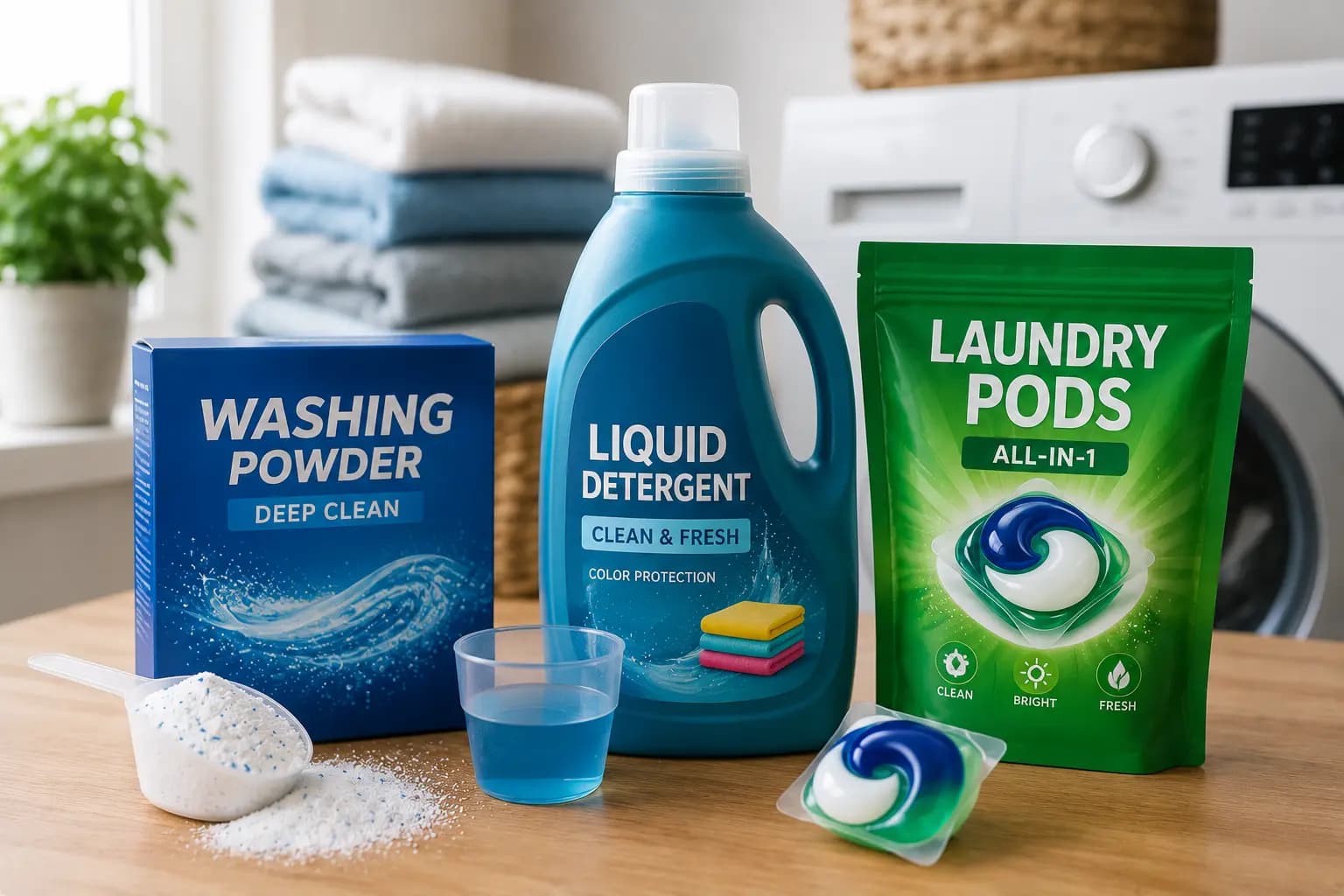
Laundry detergent no longer means only a box of washing powder. Shoppers can choose between traditional powder, liquid detergents and pre-measured laundry pods. All three formats are designed to clean clothes, but they differ in dosing, convenience and suitability for different washing situations. There is therefore no single answer to whether powder, liquid or pods are best. The right choice depends on the fabric, wash temperature, level of dirt, load size and your own routine.
The main difference is the physical format and the way each product is dosed. Laundry powder is a dry mixture, liquid detergent is already suspended in a liquid base, and a pod contains a pre-measured amount of detergent inside a soluble film.
Powder and liquid allow the user to adjust the dose according to load size and soil level. Pods provide a pre-set dose.
The intended use of the individual detergent remains important. Products may be designed for whites, colours, dark fabrics, sensitive skin or specific washing temperatures.
Laundry powder remains one of the most common detergent formats and offers excellent flexibility when it comes to dosing.
Many detergents designed specifically for white laundry are available as powders, although performance always depends on the individual formulation.
Large packs can also be convenient in households that run the washing machine frequently.
When too much powder is used or the wash conditions are unsuitable, it may not dissolve completely.
This can be more noticeable with very short cycles, low temperatures or an overloaded drum.
Any undissolved residue is particularly visible on dark fabrics.
Liquid detergent is already in liquid form and therefore mixes readily with wash water.
It is easy to measure and some products can also be used for pre-treating stains when explicitly permitted by the manufacturer.
Liquids are particularly popular for coloured and dark laundry, although the individual product label should always determine its intended use.
The main practical problem with liquid detergent is accidental overdosing. It is easy to pour more than necessary.
Using extra product increases cost without necessarily improving cleaning.
A measuring cap and the manufacturer's dosing instructions help keep the dose under control.
Laundry pods make dosing extremely simple. There is no powder to measure and no liquid to pour.
Each pod contains a pre-measured dose designed to be used according to the manufacturer's instructions.
Some pods combine several components within one product, although the exact functions vary between brands and formulas.
The main limitation is reduced dosing flexibility. A very small load does not allow you to simply use half of a pod.
Pods are also not convenient for pre-treating an individual stain because the product is designed to be used whole.
The cost per wash can sometimes be higher than with a large box of powder or bottle of liquid, although this varies considerably by product and promotion.
Each detergent format has situations where it is especially convenient. Comparing them by practical criteria is more useful than trying to name one absolute winner.
General practical comparison. Actual performance depends on the individual formula, fabric, water, temperature and cycle.
| Feature | Powder | Liquid | Pods |
|---|---|---|---|
| Dosing flexibility | ExcellentShopDe.ee rating | ExcellentShopDe.ee rating | Pre-measuredShopDe.ee rating |
| Convenience | Must be measuredShopDe.ee rating | Easy to pourShopDe.ee rating | Very easyShopDe.ee rating |
| Small loads | Dose can be reducedShopDe.ee rating | Dose can be reducedShopDe.ee rating | Less flexibleShopDe.ee rating |
| Stain pre-treatment | Less convenientShopDe.ee rating | Often convenient when permittedShopDe.ee rating | Generally not designed for itShopDe.ee rating |
| Low-temperature washes | Depends on the formulation and dissolutionShopDe.ee rating | Often very convenientShopDe.ee rating | Depends on pod and cycleShopDe.ee rating |
Scores are a general practical comparison of detergent formats, not laboratory results for specific brands.
Detergents specifically designed for white laundry are often available in powder form and may contain ingredients intended to help maintain whiteness.
That does not mean liquids or pods cannot be used for whites. The important factor is the intended purpose of the individual formula.
Always check whether the product is designed for whites, colours or universal washing.
For coloured clothes, choose a detergent labelled for colours or an equivalent designation.
Liquid detergents are particularly popular for coloured laundry, but powders and pods designed for coloured fabrics are also widely available.
The formulation is more important than whether the detergent comes in a bottle, box or pod.
Undissolved powder residue can be especially visible on dark clothing.
For this reason, many people prefer liquid detergents specifically designed for coloured or dark fabrics.
However, visible residue can also result from overdosing, overloading the drum or insufficient rinsing.
Stain performance depends primarily on the detergent formula and the type of stain rather than only on whether the detergent is a powder or liquid.
One practical advantage of liquid detergent is that some products can be applied directly as a pre-treatment when the manufacturer allows it.
Difficult stains may require a dedicated stain remover that is compatible with the fabric.
At lower temperatures, the detergent needs to disperse effectively during the selected wash cycle.
Liquid detergents are frequently chosen for cooler washes because they are already in liquid form.
Many modern powders and pods are also designed for low-temperature washing, so check the minimum temperature stated on the packaging.
A quick wash provides less time for detergent distribution, cleaning and rinsing.
Avoid excessive dosing and overloading the drum when using short cycles.
Check both the washing-machine manual and detergent instructions because not every load and detergent combination is suitable for a very short programme.
Comparing only the shelf price of each pack can be misleading. A better measure is the approximate cost per recommended wash.
Large boxes of powder and concentrated liquid detergents can offer a low cost per cycle. Pods may cost more per wash but include convenient pre-measured dosing.
Check how many standard washes the manufacturer states on each package.
Even a good detergent can perform poorly when it is incorrectly dosed.
The required amount usually depends on load size, soil level and water characteristics.
Use the manufacturer's dosing chart rather than assuming that twice as much detergent will produce twice as clean a result.
One of the most common mistakes is assuming that one detergent format is always stronger or better than the others.
In practice, the intended purpose and formulation of the individual product are often more important than whether it is a powder, liquid or pod.
Powder is a strong choice for users who value flexible dosing, large packs and a wide selection of specialised products.
Liquid detergent is convenient for everyday washing, coloured fabrics and lower-temperature cycles.
Pods are best suited to users who value maximum simplicity and a ready-made dose.
For many households, the best solution may actually be to keep more than one detergent, such as a powder for whites and a liquid for coloured laundry.
Is laundry powder, liquid or pods better?
There is no universal winner. Powder offers flexible dosing, liquid is convenient for colours and lower temperatures, while pods provide the simplest pre-measured dose.
Is liquid or powder better for coloured clothes?
The most important factor is choosing a detergent specifically designed for coloured fabrics. Liquid colour detergents are popular, but suitable powders and pods are also available.
What detergent is best for white clothes?
Powders specifically formulated for white laundry are commonly used, but the individual product's formulation and stated purpose matter more than the format alone.
Can laundry pods be used on a quick wash?
It depends on the specific pod and washing programme. Follow both the detergent manufacturer's directions and your washing-machine instructions.
Why does laundry powder leave white marks?
Possible reasons include overdosing, low wash temperatures, short programmes, an overloaded drum or insufficient rinsing.
Which is cheaper: powder, liquid or pods?
It depends on the individual product. Compare the cost per recommended wash rather than only the price of the package.