🧴
ShopDe.ee
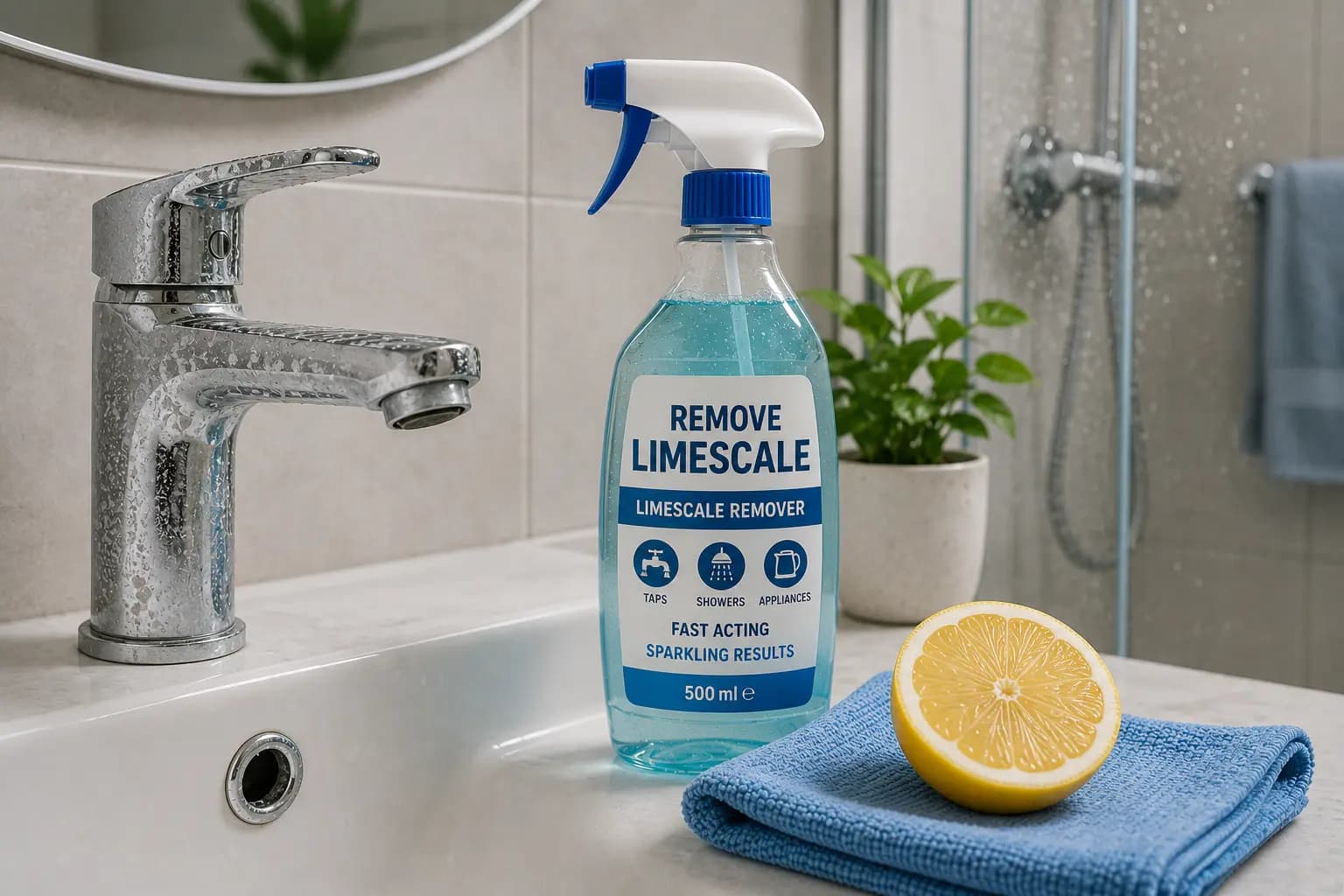
Limescale is one of the most common cleaning problems in bathrooms and kitchens. White or greyish marks are particularly noticeable on shiny taps, shower glass, tiles and sanitary surfaces. If deposits are not removed regularly, they can gradually build up and become more difficult to clean. However, the same cleaner should not automatically be used on every surface because both the material and the cleaning formula matter.
Limescale forms when water containing dissolved minerals dries on a surface. The water evaporates, while some of the mineral compounds remain behind as pale marks or harder deposits.
These marks appear particularly quickly in areas exposed to water every day, such as around taps, on shower screens, near sinks and on bathroom tiles.
Fresh deposits may initially look like a thin white film that is relatively easy to remove. When they remain on the surface for longer periods, additional mineral layers accumulate and cleaning becomes more difficult.
Mineral deposits are commonly removed with dedicated limescale cleaners or other suitable acidic cleaning formulations. The appropriate option depends on both the surface and the severity of the deposits.
For normal maintenance cleaning, a product designed for bathrooms and limescale is often sufficient. Older deposits may require a longer contact time when the manufacturer specifically allows it.
The main rule is to use a product only for its intended purpose. A stronger formula is not necessarily better because an unsuitable cleaner may damage a finish, affect shine or leave permanent marks.
Limescale commonly collects around the base of a tap, near joints and on the aerator. Even small dried water marks are easy to see on polished metal.
Apply an appropriate product according to its instructions and use a soft cloth or sponge. Allow it to work only for the period recommended by the manufacturer.
After cleaning, remove any remaining product and dry the surface with a soft cloth. Drying and gentle polishing can reduce visible water marks and restore a cleaner appearance.
Avoid metal scourers and aggressive abrasives on chrome and decorative finishes because they may scratch the surface.
Shower glass can quickly develop a combination of mineral deposits, dried water marks and residues from personal-care products. Over time, simply wiping the glass with water may no longer be sufficient.
Use a cleaner intended for shower screens and limescale. Distribute it according to the instructions on the packaging and do not exceed the recommended contact time.
After cleaning, remove or rinse away the product as instructed and dry the glass with a squeegee or soft microfibre cloth.
Removing most of the water with a squeegee after every shower can significantly reduce the amount of visible deposits that are allowed to dry on the glass.
The correct cleaning method depends heavily on the tile material. Standard glazed ceramic tiles generally tolerate many bathroom cleaners when the cleaner manufacturer explicitly allows their use on that surface.
Natural stone, marble and certain decorative materials require different care. Acidic formulations may damage acid-sensitive stone.
For this reason, identify the surface before cleaning it. If you are unsure, choose only a cleaner that explicitly states compatibility with the relevant material.
Vinegar is frequently suggested as a household method for removing mineral deposits. Its acidic nature can act on certain types of limescale, but vinegar is not suitable for every surface.
A key advantage of a purpose-made cleaner is that its manufacturer specifies the intended use, compatible surfaces, application method and recommended contact time.
For routine cleaning, choose a product not only according to cleaning strength but also according to the exact surface you intend to clean.
A general practical comparison. Always follow the requirements of the specific surface and cleaning product.
| Feature | Vinegar | Specialised cleaner |
|---|---|---|
| Light limescale removal | May help on compatible surfacesShopDe.ee rating | Usually specifically formulated for the taskShopDe.ee rating |
| Ease of use | The application method must be chosen carefully | Instructions and suitable surfaces are stated on the packaging |
| Sensitive surfaces | Can damage acid-sensitive materials | Compatibility still needs to be checked on the label |
| Smell | Strong characteristic odour | Depends on the individual product |
Neither vinegar nor a specialised cleaner should be treated as universally safe for every material.
A common mistake is assuming that a limescale cleaner that performs well on glass or ceramic will automatically be suitable for every other material.
Acidic cleaners may be unsuitable for certain natural stones and decorative finishes. Abrasive powders and rough scourers can also scratch polished surfaces.
Take particular care with black, gold, matte and other decorative tap finishes. Follow the care recommendations provided by the tap manufacturer whenever possible.
When limescale is particularly stubborn, it may be tempting to combine several products to make them work more strongly. This should not be done.
Different household cleaners can contain incompatible ingredients. It is particularly dangerous to combine acidic cleaners, including vinegar, with chlorine-bleach products.
Use only one cleaning product at a time and follow its instructions. If another product needs to be used later, completely remove the previous cleaner first.
It is difficult to prevent mineral marks entirely in areas that are constantly exposed to water, but their accumulation can be reduced considerably.
One of the simplest approaches is to avoid allowing large amounts of water to dry directly on surfaces. Use a squeegee on shower glass and periodically wipe taps and sinks dry with a microfibre cloth.
Regular maintenance cleaning also prevents deposits from developing into a thick layer that requires significantly more effort to remove later.
Sometimes the problem is not that the cleaner is too weak but that the cleaning method is unsuitable. Excessive contact time, rough scourers and inappropriate formulas can damage surfaces.
You should also avoid assuming that one product is equally suitable for glass, chrome, natural stone and painted metal.
The best method depends primarily on the surface rather than simply on the appearance of the white deposit. There are many dedicated products for compatible glass, ceramic and metal surfaces.
Natural stone, decorative finishes and other sensitive materials should only be cleaned with products that are explicitly compatible with them.
If limescale repeatedly returns, combine cleaning with prevention. Removing leftover water and preventing deposits from accumulating for months is generally easier than dealing with a heavily built-up layer.
What is the best product for removing limescale?
It depends on the surface. A specialised limescale cleaner is convenient for compatible glass, ceramic and bathroom surfaces. Always check the approved surfaces on the product label.
Can vinegar remove limescale?
Vinegar can act on some mineral deposits when used on a compatible surface, but it is not suitable for every material. It should not be used without checking compatibility with marble, limestone and other acid-sensitive surfaces.
How do I remove limescale from shower glass?
Use a cleaner designed for shower glass and limescale according to its instructions. Remove the cleaner afterwards and dry the glass. Regularly using a squeegee can help reduce future deposits.
Can I use limescale remover on taps?
Only when the product manufacturer allows it on the specific tap finish. Take particular care with matte, black, gold and other decorative finishes.
Why does limescale return so quickly?
When water droplets dry, minerals contained in the water remain on the surface. Regularly removing water from glass and taps helps reduce the accumulation of visible deposits.
Can I mix vinegar with bathroom cleaners?
No. Different household cleaning products should not be mixed. In particular, vinegar and other acidic products must not be mixed with chlorine-containing cleaners.